![[headshot] image of customer giving a testimonial (for a ai biotech company)](https://cdn.prod.website-files.com/690cdf62418694e59d87cccf/6a0dce90c493894c29ef422e_Logo-Arrow-Transparent-BG%20256.png)
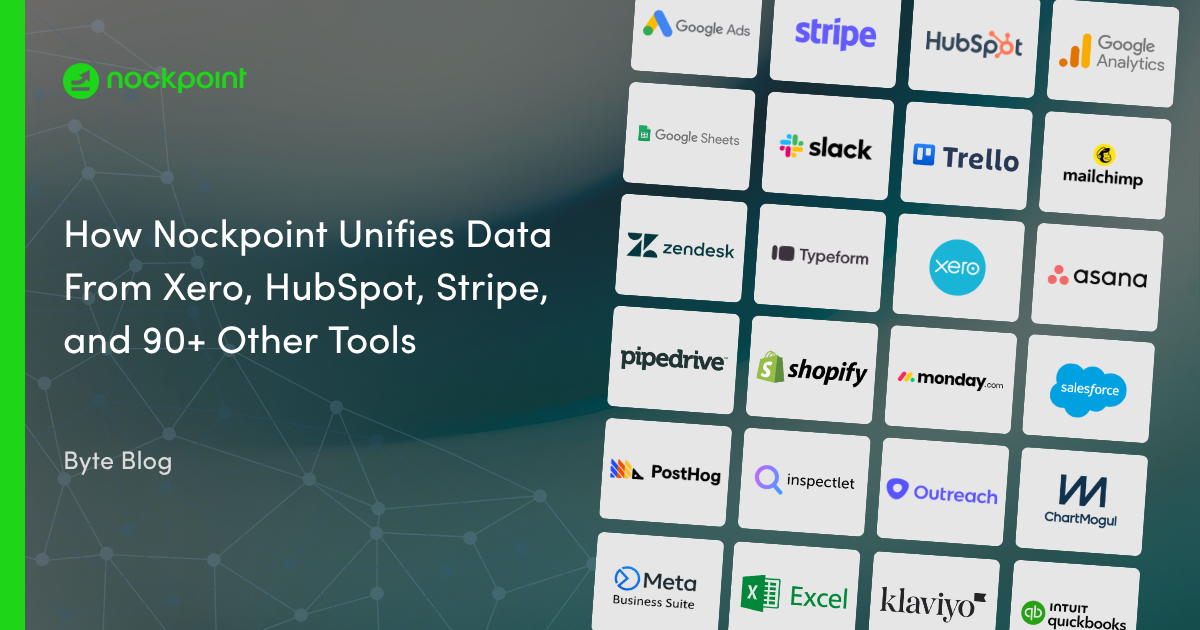
Many businesses run their business across a dozens of platforms that don't talk to each other. Revenue lives in one place, pipeline in another, support tickets somewhere else — and the only thing connecting them is whoever's turn it is to export a CSV and paste it into a spreadsheet before the Monday meeting.
That's the part that's quietly gone away for teams running Nockpoint. Here's what it actually looks like when the tools you already use are just... connected.
Closing the books without a CSV
A finance team running Xero or QuickBooks doesn't need a separate export to see revenue, expenses, and cash flow — it's already sitting next to everything else. Add Stripe for payments, Plaid for bank transaction data, or subscription platforms like Chargebee, Recurly, and Chartmogul, and the whole revenue picture updates itself, in real time, without anyone reconciling anything by hand.
Seeing pipeline and revenue in the same place
Sales teams have the same problem in reverse — a CRM full of deal data that never quite lines up with what finance is looking at. Connect HubSpot, Pipedrive, or Copper, and pipeline sits next to revenue instead of in a separate tab someone checks once a week. Teams running outbound through Outreach or Lemlist get the same thing for top-of-funnel activity.
Marketing spend next to the numbers it's supposed to move
It's hard to know if ad spend is working when the spend lives in Meta Business Suite or TikTok and the results live somewhere else entirely. Bring in Google Analytics, Google Search Console, or product analytics from PostHog, and spend and outcome finally sit in the same view. Email and lifecycle platforms — Klaviyo, Mailchimp, Customer.io — plug into the same picture.
One view across support and sales calls
Support and sales usually run on completely different tools, which means nobody sees the whole customer relationship in one place. Zendesk Support or Freshdesk ticket data can sit right next to call activity from Dialpad, Aircall, or Twilio — and team communication from Slack — instead of living in four different logins nobody cross-references.
Store performance without another tab
For teams selling online, order and revenue data from Shopify, WooCommerce, or BigCommerce shows up alongside the rest of the business instead of requiring a separate login just to check how the store's doing.
Engineering health next to the business
Engineering metrics tend to live in their own world — but they don't have to. GitHub or GitLab activity, PagerDuty incidents, and data warehouse connections to Snowflake, BigQuery, or PostgreSQL can sit in the same dashboards as revenue and pipeline — so engineering health stops being a separate report nobody outside the team reads.
Keeping the org itself visible
Even the operational side of the business follows the same pattern: BambooHR for headcount, Okta or Auth0 for access, and project tools like Asana, Trello, Monday, and JIRA — all readable in one place instead of scattered across logins only certain people check.
The part that doesn't change: nobody's handing over the keys
Every one of these connections works the same way — encrypted, credential-based, scoped to read-only wherever write access isn't the point. Connecting a tool to Nockpoint means it shows up in your dashboards. It doesn't mean Nockpoint can act on your behalf inside it.
That's the whole idea: not another tool to manage, just the ones you already run, finally talking to each other.
See the full list
The complete, current list of native Nockpoint integrations is now on the Integrations directory page. Don't see your tool mentioned here? Request an integration or talk to us, chances are it's already connected, or on the way.